Showing posts with label brooklyn dodgers. Show all posts

4/15/08

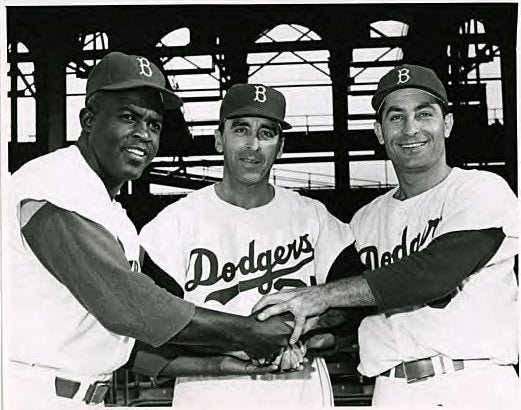
Jackie Robinson Day Around the Big Leagues

Today is Jackie Robinson day, and to celebrate, ESPN Research writer Mark Kelly put together this fascinating look (by the numbers) at Jackie Robinson's career and life. Here are the first 10, and if you want to see the rest, click here.

1/22/08

Baseball's Great Experiment, Jackie Robinson: Part IV

108 Red Stitches continues its week long tribute to African American ballplayers in honor of Martin Luther King, Jr.

Joe Black, a right handed pitcher for the Dodgers during the fifties, was one of Robinson’s roommates on road trips. He and Robinson became close and in an interview with Robinson biographer Maurey Allen, Black said that “Jackie developed this internal defense system, this thick skin, and he just didn’t let it bother him. Sure he was dying inside, but he felt the real answer was just playing well and beating the other guys” (Allen; 189). Jimmy Cannon of the New York Post gave Jackie Robinson the nickname of “the loneliest man I have seen in sports” (Rampersad; 172).
The incident between Robinson and the Phillies opened a Pandora’s box for those who wished ill of Robinson. With the press focusing on the events of the three game series, those who had ripped Robinson quietly now had the opportunity to let fly their bigotry and hatred;

“The escalation of public disclosures about the ridicule and hatred heaped on Robinson by the Phillies unearthed more snakes. Hate mail increased. Death threats were plentiful. Scribbled letters came in daily, with vulgarities” (Allen; 132).

Had the press kept the problem quiet, (fans who attended the game knew little of the verbal bashing Robinson received from Chapman and his Phillies) the hate mail and death threats might have never happened, or at least have been put off for a time.
Robinson would later write that this experience almost ended his career. He believed he didn’t deserve such treatment and wrote;

“I felt tortured and I tried just to play ball and ignore the insults. [...] But it was really getting to me. What did the Phillies want from me? What, indeed, did Mr. Rickey expect of me? I was, after all, a human being.For one wild and rage-crazed minute I thought; To hell with Mr. Rickey’s noble experiment. To hell with the image of the patient black freak I was supposed to create. I could thrown down my bat, stride over to that Phillies dugout, grab one of those white sons of bitches and smash his teeth in with my despised black fist. Then I could walk away from it all.” (Rampersad; 172-73).

Robinson’s building frustration began to poison his relationships with those that surrounded him. Eventually, the Dodger began to burn bridges with the press, both black and white. Their responses further frustrated a man who just wanted to play the game, nothing more. Wendell Smith had shown that, in his column “Sports Beat, the journalist’s relationship with Robinson was worsening and accused Robinson of showing signs of ingratitude;

“This, it seems, is time for someone to remind Mr. Robinson that the press has been especially fair to him throughout his career. Were it not for the press, Robinson would be ‘just another athlete’ insofar as the public concerned. If it had not been for the press-the sympathetic press-Mr. Robinson would have
probably still been tramping around the country with Negro teams, living under what he has called ‘intolerable conditions’. [...] Mr. Robinson’s memory, as it seems, is getting shorter and shorter. That is especially true in the case of the many newspapermen
who have befriended him throughout his career” (Rampersad; 206-7).

Sam Lacy, one of Robinson’s original ardent supporters, began to attack him. In attempts to correct Jackie, Lacy wrote in the Baltimore Afro-American;

“In his (Joe Louis) at the top of boxing he has NEVER had to deny having made a statement, he has NEVER criticized the people who gave him his chance, and he has NEVER blamed someone else for anything that happened” (Rampersad; 207).

Lacy wanted Robinson to remember where he came from and to watch his mouth. Becoming a the press’ target would only further incense Robinson, and lead to more heated confrontations between the two. Luckily, Robinson found an ally in a familiar place.

To be continued.

Baseball's Great Experiment: Jackie Robinson, Part III

Continued from Part II of the week long tribute to African American ballplayers in honor of Martin Luther King, Jr.

Officials weren’t the only ones who were leery of having a Negro play in the majors. Some of the Dodgers, in a movement spearheaded by second baseman Dixie Walker, began “plotting” against the idea of having Robinson in a Brooklyn uniform. Once manager Leo Durocher caught wind of their intentions, he quickly called a team meeting and told the rebels “I don’t care if the guy is yellow or black, or if he has stripes like a fucking zebra. I’m manager of this team, and I say he plays. What’s more, I say he can make us all rich. An’ if you can’t use the money, I’ll see that you’re traded” (Golenbock; 18).

The white press would continue to attack Rickey and Robinson, especially writers from the Deep South. Atlanta Journal sports editor Ed Danforth wrote “I don’t see why a top flight Negro ballplayer would be so anxious to play in the white leagues when he is doing so well in his own organization” (Tygiel; 74). “George White of the Dallas News described the Dodger action as ‘unfair’ to both Robinson and the South, where an established way of life was threatened” (Tygiel; 74).

The black press would begin to levy an unfair burden upon Robinson’s shoulders. They saw Robinson as a figure head that would spearhead a Civil Rights movement. “Sam Lacy cast Robinson in the role of a greater ‘national benefactor’ than President Truman. ‘Alone Robinson represents a weapon far more potent than the combined forces of all our liberal legislation,’ contended Lacy” (Tygiel; 75). Wendell Smith, a prominent figure in the black media, wrote that Robinson had “the hopes, aspirations, and ambitions of thirteen million black Americans heaped upon his broad, sturdy shoulders” (Tygiel; 75).

Robinson officially broke the color barrier in baseball on Opening Day of the 1947 season. The Brooklyn Dodgers played the Boston Braves at Ebbets Field in a game that “went off without a hitch”. Arthur Daley, of the New York Times wrote of the game;

“The debut of Jackie Robinson was quite uneventful, even though he had the unenviable distinction of snuffing out a rally by hitting into a remarkable double play. [...] The muscular Negro minds his own business and shrewdly makes no effort to push himself. He speaks quietly and intelligently when spoken to and already has made a strong impression.” (Daley; 32).

It wasn’t until the series with the Braves ended that Robinson began to face the racism that would follow him throughout his career. The Philadelphia Phillies followed the Braves into Brooklyn, and led by their manager Benjamin Chapman, began to verbally assault Robinson with everything they had;

“And Jackie Robinson was a nigger. He was also snowflake and Little Black Sambo. He was accused of sleeping with the white wives of his teammates. He was told he was spreading contagious diseases among his teammates, and his teammates were browbeaten with that time-honored phrase of bigots-nigger lover. The intensity of the attacks were beyond what anyone had ever heard. Chapman vilified Robinson every chance he had. [...] The language was so vile that National League President Ford Frick ordered Chapman to cease and desist.” (Allen; 130-31).

Chapman would later blame Robinson for keeping him out of the Hall of Fame, and pointed to this incident as “bad press” for his career. In his biography written by Arnold Rampersad, Robinson recalled the series with the Phillies and described it as one he would never forget. Robinson wrote;

“Tuesday April 22, 1947, off all the unpleasant days in my life, brought me nearer to cracking up that I ever had been.’ Starting to the plate in the first inning, I cold scarcely believe my ears. Almost as if it had been synchronized by some master conductor, hate poured forth from the Phillies dugout. Hey nigger, why don’t you go back to the cotton field where you belong? They’re waiting for you in the jungles, black boy! Hey, snowflake, which one of those white boys’ wives are you dating tonight?
We don’t want you here nigger. Go back to the bushes!” (Rampersad; 172).

And Chapman, the ring leader, wondered why he was never inducted into the Hall of Fame.

To be continued.

1/20/08

Baseball's Great Experiment: Jackie Robinson, Part I

In honor of Martin Luther King Day, the staff here at 108 Red Stitches decided honor King's Legacy by writing about African American Pioneers in the game of baseball. First up, is "Hall of Famer" Jackie Robinson. Robinson is most famous for breaking baseball's color barrier while playing for the Dodgers. Often overlooked is the way the media and others treated him at the time. Here is the first installment of "Baseball's Great Experiment; Jackie Robinson".

The Constitution says that “all men are created equal”. African Americans served with honor throughout World War One and World War Two. In the North, many African Americans were beginning to realize the dreams their ancestors laid out before them. America, during the middle of the 1940’s and the early 1950’s was undergoing a period of change. Change (although slow at first) effected everything except for the heart of America; baseball. Baseball has been given the title “America’s Pastime”, and up until the end of the second World War, baseball had refused to break down the color barrier that had clouded the game. All that would change with the help of “the founder of the farm system” and a no-name from the Negro Leagues.

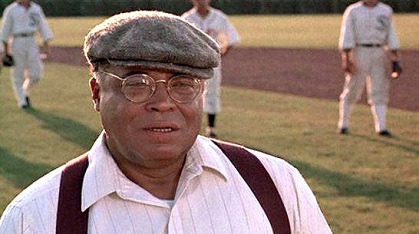
In the film “Field of Dreams” Terrance Mann (played by James Earl Jones) says;

“The one constant through all the years has been baseball.
America has rolled by like an army of steamrollers. It’s been
erased like a blackboard, rebuilt, and erased again. But baseball
has marked the time. This field, this game, is a part of our past. It reminds us of all that once was good, and what could be again.”(baseball-almanac.com)


There has never been a greater quote used to describe baseball, and never has their been a quote like this that so accurately depicts what Branch Rickey and Jackie Robinson were trying to accomplish during the Summer of 1947; erase America’s blackboard and rebuild it.

Born Jack Roosevelt Robinson on January 31, 1919, the son of a farmer from Cairo, Georgia would soon face one of life's many hardships that would shadow his life. His father, Jerry Robinson, (owner of a small farm) eventually grew weary of the monotonous motion of his life, and ran away to Florida with another woman. Jackie’s mother decided that Cairo was no place to raise her family, so they moved to Pasadena, California. In his book, Jackie Robinson, A Life Remembered, Maury Allen interviewed Mack Robinson, one of Jackie’s older brothers. Mac said “What my mother didn’t know, when she brought us here, what none of us knew, was that Pasadena was as prejudiced as any town in the South. They let us in alright, but they wouldn’t let us live” (Allen; 19).

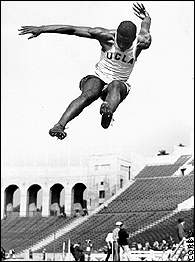
Robinson would eventually attend UCLA because of the college’s proximity to his mother. There, Robinson excelled in football, basketball, and most importantly baseball. It was after his college days that Jackie Robinson began to show a glimpse of what was to come.

Just before being deployed oversees to fight in World War Two, Robinson engaged in a dispute that almost ended his military career in disgrace. Robinson got on a bus at Camp Hood (his military base located in Texas) to go to a hospital in Temple. Robinson decided to sit in one of the seats located in the middle of the bus and, eventually, an argument between Milton Renegar (the driver) and Robinson ensued. Renegar commanded Robinson to move to the back and threatened to cause trouble with his officers once they reached the hospital. Robinson refused. “Robinson had obeyed Texas law requiring Jim Crow seating on the bus. But he also knew that the Army now forbade segregation on its military bases” (Rampersad; 102). Things began to spiral out of control, and soon enough, Robinson found himself in front of a court martial panel. In one of Robinson’s biographies, Arnold Rampersad writes about the trail:

“Clearly, almost all of the whites involved were genuinely
mystified that Robinson disliked being badly treated. The white
private, Ben Mucklerath, denied that he had called Robinson a
nigger, as Robinson charged; but Corporal Elwood, the first MP
on the scene, testified the Mucklerath ‘came over to the pickup
and asked me if I got that nigger Lieutenant. Right then the
Lieutenant said, ‘ Look here, you s son-of-a-bitch, don’t you call
me no nigger’. (Rampersad; 107)

Robinson’s testimony to those hearing the court martial open a portal that reveals the strength and intestinal fortitude that he latter called upon when dealing with the media during his baseball career. Robinson took the stand, on his own free will, and delivered a speech that would effect the outcome of his trial;

“ To the question ‘Do you know what a nigger is?’ Robinson
replied: “I looked it up once, but my grandmother gave me a good
definition, she was a slave, and she said the definition of the word
was a low, uncouth person, and pertains to no one in particular; but I
don’t consider that I am low and uncouth. I looked it up in the
dictionary afterwards and it says the word nigger pertains to the
negroid or negro, but it is also a machine used in a saw mill for pushing
logs into the saws. I objected to being called a nigger by this private
or by anybody else. When I made this statement that I did not like
to be called a nigger, I told the Captain, I said, ‘If you call me a nigger,
I might have to say the same thing to you...I don't not consider
myself a nigger at all,I am a negro, but not a nigger.’ (Rampersad; 108).

Robinson was soon after acquitted of all charges against him, but the trail lasted long enough where Robinson wasn’t able to meet up with the rest of his battalion, who had just left for Omaha Beach. “On November 28, 1944, Robinson was ‘honorably relieved from active duty’ in the U.S. Army ‘by reason of physical disqualification’ (Rampersad; 111).

After his discharge, Robinson soon found himself in a new uniform.

To be continued.