Showing posts with label Jules Tygiel. Show all posts

1/22/08

Baseball's Great Experiment: Jackie Robinson, Part III

Continued from Part II of the week long tribute to African American ballplayers in honor of Martin Luther King, Jr.

Officials weren’t the only ones who were leery of having a Negro play in the majors. Some of the Dodgers, in a movement spearheaded by second baseman Dixie Walker, began “plotting” against the idea of having Robinson in a Brooklyn uniform. Once manager Leo Durocher caught wind of their intentions, he quickly called a team meeting and told the rebels “I don’t care if the guy is yellow or black, or if he has stripes like a fucking zebra. I’m manager of this team, and I say he plays. What’s more, I say he can make us all rich. An’ if you can’t use the money, I’ll see that you’re traded” (Golenbock; 18).

The white press would continue to attack Rickey and Robinson, especially writers from the Deep South. Atlanta Journal sports editor Ed Danforth wrote “I don’t see why a top flight Negro ballplayer would be so anxious to play in the white leagues when he is doing so well in his own organization” (Tygiel; 74). “George White of the Dallas News described the Dodger action as ‘unfair’ to both Robinson and the South, where an established way of life was threatened” (Tygiel; 74).

The black press would begin to levy an unfair burden upon Robinson’s shoulders. They saw Robinson as a figure head that would spearhead a Civil Rights movement. “Sam Lacy cast Robinson in the role of a greater ‘national benefactor’ than President Truman. ‘Alone Robinson represents a weapon far more potent than the combined forces of all our liberal legislation,’ contended Lacy” (Tygiel; 75). Wendell Smith, a prominent figure in the black media, wrote that Robinson had “the hopes, aspirations, and ambitions of thirteen million black Americans heaped upon his broad, sturdy shoulders” (Tygiel; 75).

Robinson officially broke the color barrier in baseball on Opening Day of the 1947 season. The Brooklyn Dodgers played the Boston Braves at Ebbets Field in a game that “went off without a hitch”. Arthur Daley, of the New York Times wrote of the game;

“The debut of Jackie Robinson was quite uneventful, even though he had the unenviable distinction of snuffing out a rally by hitting into a remarkable double play. [...] The muscular Negro minds his own business and shrewdly makes no effort to push himself. He speaks quietly and intelligently when spoken to and already has made a strong impression.” (Daley; 32).

It wasn’t until the series with the Braves ended that Robinson began to face the racism that would follow him throughout his career. The Philadelphia Phillies followed the Braves into Brooklyn, and led by their manager Benjamin Chapman, began to verbally assault Robinson with everything they had;

“And Jackie Robinson was a nigger. He was also snowflake and Little Black Sambo. He was accused of sleeping with the white wives of his teammates. He was told he was spreading contagious diseases among his teammates, and his teammates were browbeaten with that time-honored phrase of bigots-nigger lover. The intensity of the attacks were beyond what anyone had ever heard. Chapman vilified Robinson every chance he had. [...] The language was so vile that National League President Ford Frick ordered Chapman to cease and desist.” (Allen; 130-31).

Chapman would later blame Robinson for keeping him out of the Hall of Fame, and pointed to this incident as “bad press” for his career. In his biography written by Arnold Rampersad, Robinson recalled the series with the Phillies and described it as one he would never forget. Robinson wrote;

“Tuesday April 22, 1947, off all the unpleasant days in my life, brought me nearer to cracking up that I ever had been.’ Starting to the plate in the first inning, I cold scarcely believe my ears. Almost as if it had been synchronized by some master conductor, hate poured forth from the Phillies dugout. Hey nigger, why don’t you go back to the cotton field where you belong? They’re waiting for you in the jungles, black boy! Hey, snowflake, which one of those white boys’ wives are you dating tonight?
We don’t want you here nigger. Go back to the bushes!” (Rampersad; 172).

And Chapman, the ring leader, wondered why he was never inducted into the Hall of Fame.

To be continued.

1/21/08

Baseball's Great Experiment, Jackie Robinson: Part II

Continued from Part I of 108 Red Stitches tribute to African American Ballplayers, part of a week long series honoring Dr. Marting Luther King, Jr.

After his discharge from the Army, Robinson soon found himself in a new uniform; the uniform of the Kansas City Monarchs, a baseball team in the Negro League. At the time Robinson began playing for the Monarchs, the Negro League had just suffered a setback in attempts to break down the color barrier in baseball. Major League baseball was looking for excuses to keep black players out of the league and eventually struck gold in the form of the black press. In his novel Baseball’s Great Experiment, Jules Tygiel discusses the actions of a prominent member of the black press, Sam Lacy.

“Lacy and other black writers frequently criticized the absence
of fundamentals in the Negro Leagues. Some black athletes
excelled in hitting or fielding or base running, Lacy contended,
but few demonstrated the all-around talent necessary for
success in the majors” (Tygiel; 84).

In attempts to jump start or motivate the players in the Negro Leagues, Lacy wrote “I am reluctant to say that we haven’t a single man in the ranks of colored baseball who could step into the major league uniform and disport himself after the fashion of a big leaguer” (Tygiel; 84). This comment gave the authorities of “white baseball” something to build off of. If their own press didn’t believe that blacks could play in the majors, why should we give them a chance to prove themselves?
Robinson would continue to play for the Monarchs as the racially driven debate continued. Robinson wasn’t the best player in the Negro Leagues, so it was a surprise to him when the general manager of the Brooklyn Dodgers approached him with an offer to play for his franchise. In an essay written by Peter Dreier titled “Jackie Robinson’s Legacy; Baseball, Race and Politics” the topic of “baseball’s great experiment” is discussed. Dreier writes;

“He (Branch Rickey) knew that if the Robinson ‘experiment’
failed, the cause of baseball integration would be set back for
many years thereafter. He could have chosen other Negro
League players greater talent or name recognition, but he
wanted someone who could be what today we call a ‘role-model’.
Robinson was articulate and well educated. Although born in the
segregated Deep South, he lived among whites in his Pasadena
neighborhood, at school, and in college, and he played on
integrated sports teams.” (44).

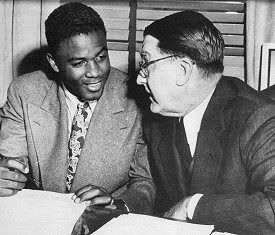
Branch Rickey invited members of the press to attend the signing of Robinson to a major league contract. Once the press realized why they had been invited, the room fell eerily quiet. The writers realized this was the beginning of a new era in baseball, and frankly, they did not know how to handle the situation. In a sign of the times Al Parsley, of the Montreal Herald, wrote in his article of Robinson “His color is the hue of ebony. By no means can he be called a brown bomber or a chocolate soldier” (Tygiel; 72). This was a chance for the members of the press to introduce a new ballplayer to the world, but all they could concentrate on was the color of his skin.
Members of the white press began to doubt Rickey’s selection of Robinson to break the barrier. Will Connally, a sportswriter from San Francisco, spearheaded that belief. Connally considered one of Robinson’s U.C.L.A. teammates, Kenny Washington, to be a better pioneer. Connally wrote “Kenny is a ‘white man’, a nice guy. [He] quoted Californians as saying, “Robinson, he’s a troublemaker” (Tygiel; 75-6).
The black press (or members within the black press) treated this situation far more differently than the white press did. Jules Tygiel writes “black newspapers placed the Robinson story on the front page, hailed the breakthrough in their editorials, and devoted a substantial proportion of their papers to the event” (Tygiel; 78-9). Robinson was quickly elevated to the same platform that held the likes of Joe Louis and Branch Rickey quickly became popular in many black communities.
Once Robinson signed on with the Dodgers, he was assigned to their farm team located in Montreal. The Dodgers hoped this would give him some shelter from the American media that would eventually try to break him. A year before Robinson would make his debut with the Dodgers, New York Times columnist Roscoe McGowen wrote in one of his articles “A bit of tradition was shattered today when Negroes were seated throughout the stands. Heretofore they have sat only in the small bleachers back of first base reserved for them. Possibly the Jackie Robinson influence...” (McGowen). In his essay “The Greatest Season, From Jackie Robinson to Sammy Sosa”, Roger Kahn writes about the task Robinson was about to undertake;

“With precious little help from the press, the umpires, and the
other ball players, Jackie Robinson integrated major league
baseball in 1947. [...] The policy of segregation that began in
1885 was unofficial and absolute. No documents attest to
baseball’s apartheid. There was simply an understanding among
every major league club owner and every minor league club owner
for more than sixty years that no blacks could play in so-called
organized ball.” (Kahn; 38).

Robinson’s entry into the league caused quite a stir amongst baseball officials. An article ran in the New York Times with different officials perspectives on Branch Rickey’s newest signing. Frank Shaughnessy, the president of the International League (where Robinson would play in the minors) confirmed what Kahn had written in his article on race relations in baseball;

“There’s no rule in baseball that says a Negro can’t play with a
club in organized ball. As long as any fellow’s the right type and
can make good and can get along with other players, he can play
ball” (Club Heads Give Views; 17).

Clark Griffith, the President of the Senators believed that baseball had no right “stealing” players from the Negro Leagues when he stated “The only question that occurs to me is whether organized ball has the right to sign a player from the Negro League. That is a well-established league and organized baseball shouldn’t take their players. The Negro league is entitled to full recognition as a full-fledged baseball organization” (Club Heads Give Views; 17). In short, Griffith was stating that blacks should stay where they belong, in the Negro Leagues. Horace Stoneham’s response to the signing of Robinson wasn’t much brighter; “the primary responsibility we have is finding places for our returning Service men, numbering into the hundreds, and only if they prove incapable will new players (blacks) be placed on our clubs.” (Club Heads Give Views; 17).

To be continued.